
Duct Sealing Cost in Knoxville: What You’ll Actually Pay to Stop Crawl Space Air From Entering Your Home
Professional duct sealing in Knoxville typically runs $950 to $2,400 for a standard residential system, with most crawl-space flex-duct jobs falling between $1,200 and $1,800. The exact figure depends on your home’s linear footage, how many boot connections need sealing, and whether we can reach everything from the crawl space or need to cut access points. Call (855) 774-4207 for a free, exact quote — we inspect first, then seal, so you’re never guessing.
Here’s what changes the math in this market: Knoxville’s humidity doesn’t stay outside. When your air handler fires up, unsealed joints in flex duct running through a 70%-plus-humidity crawl space become active suction points. You’re not just losing conditioned air — you’re pressurizing your living space with whatever’s under your house. That’s a different cost-benefit equation than the energy-savings pitch you’ll read on generic pages, and it’s why we approach sealing as a moisture-defense and air-quality intervention, not a utility-bill tweak.
Why Duct Sealing in Knoxville Is Different From Dry-Climate Markets
Most duct sealing content comes from Arizona or Texas contractors who’ve never pulled a grille in a Tennessee Valley crawl space. Their angle is straightforward: seal leaks, save on heating and cooling, payback in 3-5 years. That ignores the biology of what happens here.
Knoxville sits in a natural bowl formed by the Tennessee Valley. Humidity hangs. Crawl spaces — the default foundation type for West Knoxville suburbs and South Knoxville corridors built from the 1960s through the 1990s — regularly exceed ambient outdoor moisture levels. When your heat pump cycles (and TVA’s cheap-electric history means most local homes run heat pumps that recirculate air year-round), every unsealed collar and sagging flex joint pulls that saturated air directly into your supply stream.
We’ve opened ducts in Bearden ranch houses where the interior liner was speckled with active mold growth at the 6 o’clock position — the low point where condensation pools. We’ve found rodent nesting material packed around boot connections in Fountain City crawl spaces, the entry gap so obvious once you’re looking at it that you wonder how the homeowner wasn’t smelling it. The point isn’t to gross you out. It’s that sealing here prevents ongoing contamination that cleaning alone can’t solve — you can scrub a duct spotless, but if you’re still drawing crawl space air through a 3/8-inch gap at the plenum, you’re back where you started in six months.
That changes what “duct sealing cost” actually represents. You’re not buying efficiency. You’re buying a barrier between your breathing air and an environment that supports mold, bacteria, and whatever else is decomposing under your floorboards.
What Drives the Price: Breaking Down Real Knoxville Jobs
After 11 years specializing exclusively in duct systems across this city, we’ve learned to quote by what we find, not by square footage alone. Two 2,000-square-foot homes in Knoxville can have wildly different sealing scopes depending on duct layout, access, and prior workmanship.
| Component / Scenario | Typical Range |
|---|---|
| Basic flex-duct sealing: standard ranch, accessible crawl space, 8-12 boot connections | $950 – $1,400 |
| Moderate complexity: multi-level home, extended trunk lines, 15-20 connections, some access limitations | $1,400 – $2,000 |
| Complex or large home: 2,500+ sq ft, extensive hard-pipe transitions, multiple zones, cut-in access required | $2,000 – $2,400+ |
| Aerosol duct sealing (whole-system pressurized sealant) — rare residential need, but available | $2,500 – $4,000 |
| Individual repair + spot seal (broken collar, disconnected boot, localized fix) | $250 – $600 |
The biggest variable most homeowners don’t anticipate: access geometry. Knoxville’s hilly terrain pushed builders to tuck mechanicals into tight crawl spaces with minimal headroom. If we’re working on our bellies with a headlamp, every connection takes longer. If the previous installer used zip-ties and prayer to hang flex duct, and it’s now sagging onto wet ground, we’re not just sealing — we’re re-supporting, re-routing, and sometimes replacing damaged sections before we can seal anything.
Number of boot connections matters more than linear footage. A boot — where the duct meets the floor or wall register — has two potential leak points: the collar-to-duct connection and the boot-to-floor seal. A home with 20 boots has 40 potential failure points. A home with 8 boots has 16. The math is that simple, and it’s why we inspect before we quote.
Mastic, Metal Tape, or Aerosol: What We Use and Why It Matters Here
This is where most duct sealing pages go vague. They’ll say “professional-grade materials” and move on. The material choice actually determines whether your seal survives a Knoxville crawl space.
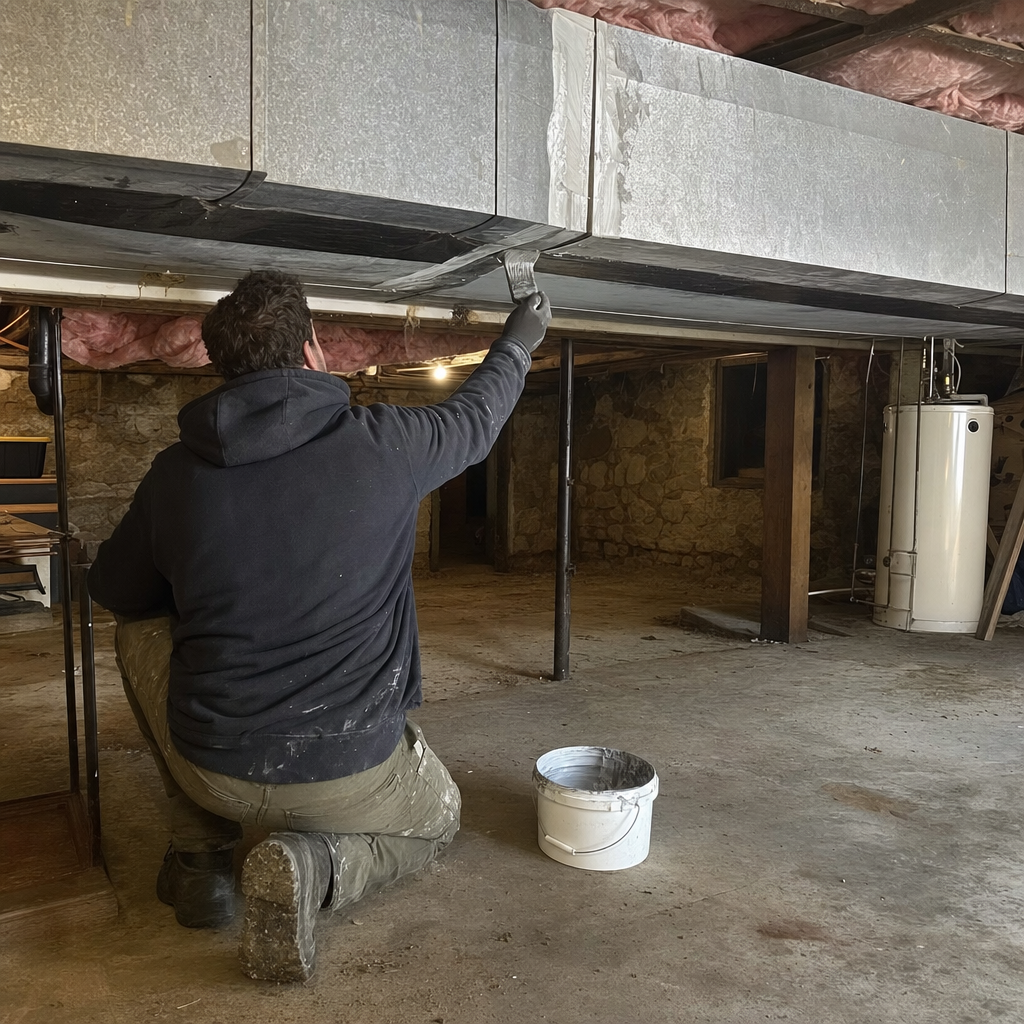
Mastic — a thick, fiber-reinforced paste brushed onto joints — is our default for flex-duct connections in humid environments. It remains slightly flexible after curing, so it doesn’t crack when the duct vibrates or when seasonal temperature swings expand and contract the metal fittings. In a crawl space where condensation forms on duct exteriors, mastic’s water resistance outlasts any tape adhesive. We apply it with a brush or gloved hand, work it into the fabric-to-metal transition, and let it skin before the system runs. Done right, it’s a 20-year solution.
Metal-backed tape (not the cloth “duct tape” from hardware stores) has its place: sealing hard-pipe seams, temporary holds during assembly, or spots where mastic can’t be worked into a tight angle. But tape adhesive degrades faster in high humidity. We’ve peeled failing tape off five-year-old jobs where the installer relied on it exclusively. We use it as backup, not primary defense.
Aerosol sealing — pressurizing the duct system and fogging sealant particles that accumulate at leak points — is impressive technology. We don’t default to it for residential flex-duct systems because the sealant buildup can restrict already-undersized Knoxville ductwork, and the cost rarely justifies the marginal gain over proper manual sealing. We reserve it for specialized commercial applications or historic homes where physical access is genuinely impossible.
Robert Garcia, our Owner & Lead Technician, makes the call on every job. “If I wouldn’t put it in my own house, I’m not going to recommend it for yours.” That’s the standard. In a humid crawl space, that standard means mastic-first, tape as reinforcement, aerosol only when there’s no other way.
Common Local Scenarios: What We Actually See on Knoxville Jobs
These aren’t hypotheticals. These are the patterns that repeat across 11 years of local work, and they shape what you’ll pay.
- The 1970s West Knoxville ranch with original flex duct: Sagging runs resting on damp crawl space soil, every boot collar loose from decades of vibration, insulation jacket degraded and holding moisture. Typical scope: re-support all runs, replace damaged sections, seal 10-12 connections. $1,400–$1,800.
- The post-2000 Sequoyah Hills build with “sealed” ducts that weren’t: Builder used tape only, no mastic, on all plenum connections. Tape is now brittle, peeling at edges. System pulls that distinctive brick-red East Tennessee clay dust through gaps — we’ve shown homeowners the staining on their return duct walls. Spot-seal and verify with pressure test. $800–$1,200.
- The South Knoxville renovation with mixed hard-pipe and flex: Previous owner DIY’d transitions with hardware-store tape and no mechanical support. Transitions are leaking, one boot is completely disconnected behind a finished wall. Requires limited drywall access, proper reconnection, full seal. $1,600–$2,200.
- The allergy-driven call from a Farragut family with a new baby: No obvious symptoms except persistent congestion, high utility bills, and a musty note when the system first cycles. Inspection finds multiple leaks drawing crawl space air, humidity readings in supply plenum 15% above ambient. Full seal plus sanitizing. $1,200–$1,700 for sealing; sanitizing additional.
Every one of these jobs started with our full Duct Repair & Sealing inspection. We don’t guess from a phone description. We look, we measure leakage with a pressure pan, we photograph what we find, and we quote from there.
The Hidden Cost of Two-Contractor Jobs
Here’s a pattern we see too often: a homeowner pays an HVAC company for a “duct cleaning” that doesn’t include sealing. The cleaning reveals leaks. The HVAC company doesn’t do sealing, or subcontracts it, or quotes it as a separate visit with a separate mobilization fee. Now you’ve paid for two truck rolls, two inspections, and you’re managing two schedules.
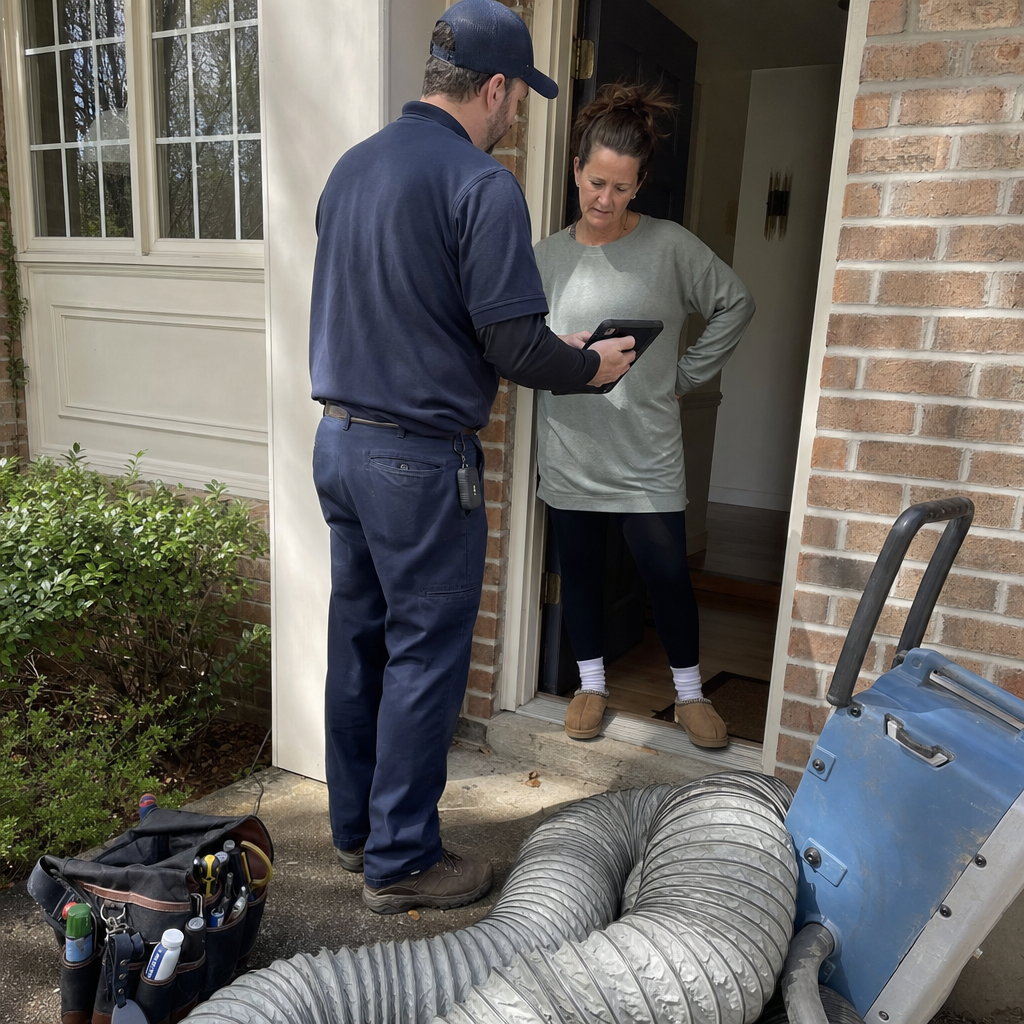
We don’t operate that way. Vanguard handles the full scope — cleaning, inspection, repair, and sealing — in one visit with one crew. Our Rotobrush agitation systems and Nikro negative-air machines handle the cleaning. Robert Garcia or our trained team handles the sealing. If we find a disconnected boot or a compromised section during cleaning, we fix it then, not in a callback three weeks later.
That integration matters for cost. A standalone sealing quote from a company that only seals often runs higher because they’re covering mobilization for a single task. Our combined workflow spreads that overhead across the full service. More importantly, the person who cleaned your ducts is the person who seals them — so there’s no handoff, no “well, the other guy said…”
912 homeowners have rated us 4.7 stars. A volume like that doesn’t come from one-off jobs. It comes from doing the full job, showing the homeowner what we found, and standing behind the work.
When Sealing Isn’t Enough: Repair vs. Replace Decisions
We’re upfront about this because it’s the question every skeptical homeowner should ask. Sometimes we open a crawl space and the duct is too far gone to seal cost-effectively.
Flex duct has a functional lifespan of 15-25 years depending on installation quality and environment. In a humid Knoxville crawl space with poor vapor barrier coverage, we’ve seen 10-year-old duct with liner delamination, insulation saturated to the point of collapse, and rodent damage that makes patching pointless. Sealing that duct is throwing good money at bad material.
Our inspection includes this assessment. If we recommend replacement over sealing, we’ll show you why — photo evidence, pressure test numbers, and a clear comparison. We’re not interested in a seal job that fails in two years because the substrate was rotten. That’s not how you build 912 reviews at 4.7 stars.
We carry Guardsman and Honeywell materials for replacement work when needed, and we size new duct properly — correcting the undersizing we routinely find in older Knoxville homes where builders cheated on trunk diameter to save a few dollars.
FAQs
Most residential duct sealing jobs in Knoxville fall between $1,200 and $1,800, with simpler ranch homes starting around $950 and complex multi-level systems reaching $2,400 or more. The exact cost depends on your home’s number of duct connections, crawl space accessibility, and whether any damaged sections need repair before sealing. Call (855) 774-4207 for a free inspection and exact quote — estimates are always free.
Sealing is cheaper when the duct material itself is sound — typically 60-70% less than full replacement for a standard system. However, if your flex duct liner is delaminating, insulation is moisture-saturated, or rodent damage is extensive, replacement becomes the more cost-effective long-term choice. We inspect and give you the honest crossover point; we’ve walked away from seal jobs when the duct was too degraded to justify it. Call (855) 774-4207 and we’ll show you exactly what you’re working with.
In Knoxville’s humid climate, sealing improves air quality in ways dry-climate markets don’t experience — unsealed joints actively draw crawl space air laden with mold spores, soil particulates, and pest debris into your living space every time the system runs. We’ve measured supply plenum humidity 15% above ambient in leaking systems, and we’ve documented mold growth inside ducts where crawl space moisture was being pulled in continuously. Energy savings are real but secondary here; the primary benefit is stopping that contamination pathway.
A standard residential sealing job takes 3 to 6 hours depending on complexity, and yes — we routinely complete cleaning, inspection, and sealing in a single visit. That’s actually our preferred workflow, since we’re already mobilized, already familiar with your system’s layout, and can verify our seal with a post-work pressure test. Same-day completion means one disruption to your schedule, not two. Call (855) 774-4207 to book a combined service appointment.
Ready to Stop Crawl Space Air From Entering Your Home?
Unsealed ducts in a Knoxville crawl space aren’t an efficiency problem — they’re an open pathway between your breathing air and everything that thrives in dark, humid, undisturbed spaces. We’ve spent 11 years sealing that pathway, one connection at a time, with commercial-grade equipment and no handoffs to inexperienced crews. Get a free inspection, see what your system actually looks like, and know exactly what sealing will cost before we start. Call (855) 774-4207 or reach out through our site to schedule — we answer calls directly, and Robert Garcia still personally oversees every job we book.
Written by Robert Garcia, Owner & Lead Technician at Vanguard Air Duct Cleaning Knoxville, serving Knoxville, TN.